Putin's Preventive Counter-Revolution by Robert Horvath
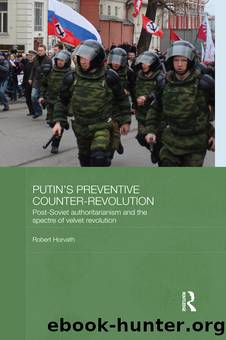
Author:Robert Horvath [Horvath, Robert]
Language: eng
Format: epub
Tags: History, Europe, Former Soviet Republics, Political Science, World, Russian & Former Soviet Union
ISBN: 9780415694216
Google: gEx3lhUIgv4C
Publisher: Routledge
Published: 2013-01-15T03:43:21+00:00
The âspy rockâ affair
That evening, the debate was transformed by the broadcast of a television documentary that bolstered Putinâs arguments for controls over the NGO sector. The documentary, titled âSpiesâ, alleged links between leading Russian human rights organisations and Western intelligence agencies. It appeared on âSpecial Correspondentâ, a current affairs programme on the Rossiya channel hosted by Arkadii Mamontov, a journalist who was to play a conspicuous role in the âpreventive counter-revolutionâ. Mamontovâs exposé revolved around the cloak-and-dagger activities of four diplomats at the British embassy in Moscow, who had used a receiver concealed in a small rock to communicate with their agents. In a sign of FSB cooperation in the production, the documentary featured surveillance footage of the diplomats circling the rock. But the Mamontov was less interested in the world of espionage than in the fact that âone of the British diplomats, or rather spies, was linked to several Russian non-governmental public organisationsâ. This diplomat was Mark Doe, a 27-year-old Second Secretary at the embassy, who was filmed, disguised as a student backpacker, travelling to the rock and removing it after an apparent malfunction. In his diplomatic capacity, Doe had also served as a coordinator of the Global Opportunities Foundation, an initiative of the British Foreign Office which had dispensed grants to an array of Russian NGOs. Mamontov exploited this fact to insinuate that Doeâs espionage activities extended to his interactions with civil society:
An intelligence agent, Mark Doe was professionally obliged to recruit Russian citizens to work for British intelligence, he had access, and most importantly unlimited opportunities to work with and contact many public figures in Russia. Through him, money was transferred to several nongovernmental public organisations.
Here was the fuse for Mamontovâs bombshell: the beneficiaries of Doeâs largesse included the Moscow Helsinki Group (MHG), the oldest and one of the most respected of Russiaâs human rights NGOs, which had been established in 1976 by Yurii Orlov to monitor Soviet violations of the human rights provisions of the Helsinki Final Act. Presenting a document that was later dismissed by Ludmila Alekseeva, the groupâs chairman, as a forgery, Mamontov showed Doeâs incriminating signature beneath a grant awarding £23,000 to the MHG. Further evidence was uncovered on the MHGâs own website, which recorded Doeâs authorisation of a payment of £5,719 to the Eurasia Foundation for the support of low-circulation regional newspapers. âThe money [flows] like a riverâ, commented Mamontov, before moving to his final exhibit: a programme, also supervised by Doe, for âthe creation of a network of schools for public inspectors in distant regions of Northern Siberia and the Far Eastâ. Exploiting the vagueness of this description, Mamontov insinuated that the inspectors were engaged in something sinister: âWhat kind of inspectors? What will they look at in our regions of northern Siberia and the Far East? One can only guess.â
According to Mamontov, the moral of the âspy rockâ tale was that Russiaâs civil society was under threat from its adversaries. Gloating that the British embassy and other Western diplomatic
Download
This site does not store any files on its server. We only index and link to content provided by other sites. Please contact the content providers to delete copyright contents if any and email us, we'll remove relevant links or contents immediately.
Spell It Out by David Crystal(36215)
Life for Me Ain't Been No Crystal Stair by Susan Sheehan(35890)
The Great Music City by Andrea Baker(33327)
Cecilia; Or, Memoirs of an Heiress — Volume 1 by Fanny Burney(32709)
Cecilia; Or, Memoirs of an Heiress — Volume 2 by Fanny Burney(32073)
Cecilia; Or, Memoirs of an Heiress — Volume 3 by Fanny Burney(32055)
Professional Troublemaker by Luvvie Ajayi Jones(29741)
The Secret History by Donna Tartt(19438)
We're Going to Need More Wine by Gabrielle Union(19157)
Twilight of the Idols With the Antichrist and Ecce Homo by Friedrich Nietzsche(18756)
All the Missing Girls by Megan Miranda(16607)
Cat's cradle by Kurt Vonnegut(15526)
For the Love of Europe by Rick Steves(14829)
Pimp by Iceberg Slim(14775)
Bombshells: Glamour Girls of a Lifetime by Sullivan Steve(14208)
Norse Mythology by Gaiman Neil(13538)
Talking to Strangers by Malcolm Gladwell(13517)
Fifty Shades Freed by E L James(13337)
The Social Justice Warrior Handbook by Lisa De Pasquale(12283)
